
Circle of Security Parenting is one of the most widely used parenting programs in the world. More than 50,000 practitioners have been trained in it, and if you work with families in Australia, there's a good chance you've delivered it, referred to it, or sat in a team meeting where someone drew the circle on a whiteboard. I've done all three.
So when a new meta-analysis landed in the Journal of Child Psychology and Psychiatry concluding there are no robust effects of COSP on parenting, parents or children, it got my attention.
I actually like Circle of Security a lot. So, I think the useful question here, for anyone who builds or delivers parenting programs (me included), is what this tells us about how parents actually change.
What Circle of Security gets right
Let me start with what it does well, because it's a lot.
The language is wonderful. Phrases like “safe haven”, “secure base”, "shark music" and "bigger, stronger, wiser and kind" stick with parents for years, and they give families and clinicians a shared shorthand that's warm rather than clinical. The graphic is one of the best pieces of psychoeducation I've seen. A parent can look at it once and grasp that a child heading off to explore and a child running back for comfort are the same relationship doing two different jobs.
Most of all, it gives parents a whole new lens on behaviour. Instead of seeing kids as defiant, manipulative and attention-seeking, COS helps parents see the underlying needs the child has for comfort, exploration and protection.
What the study found
The meta-analysis, by Marian Bakermans-Kranenburg, Megan Galbally, Erinn Hawkins and Marinus van IJzendoorn, pooled all eight randomised controlled trials of COSP, covering 1,094 families. They looked at three areas: parenting itself (sensitivity, reflective functioning, attitudes), parents' own mental health (stress, depression, anxiety), and children's attachment security and behaviour.
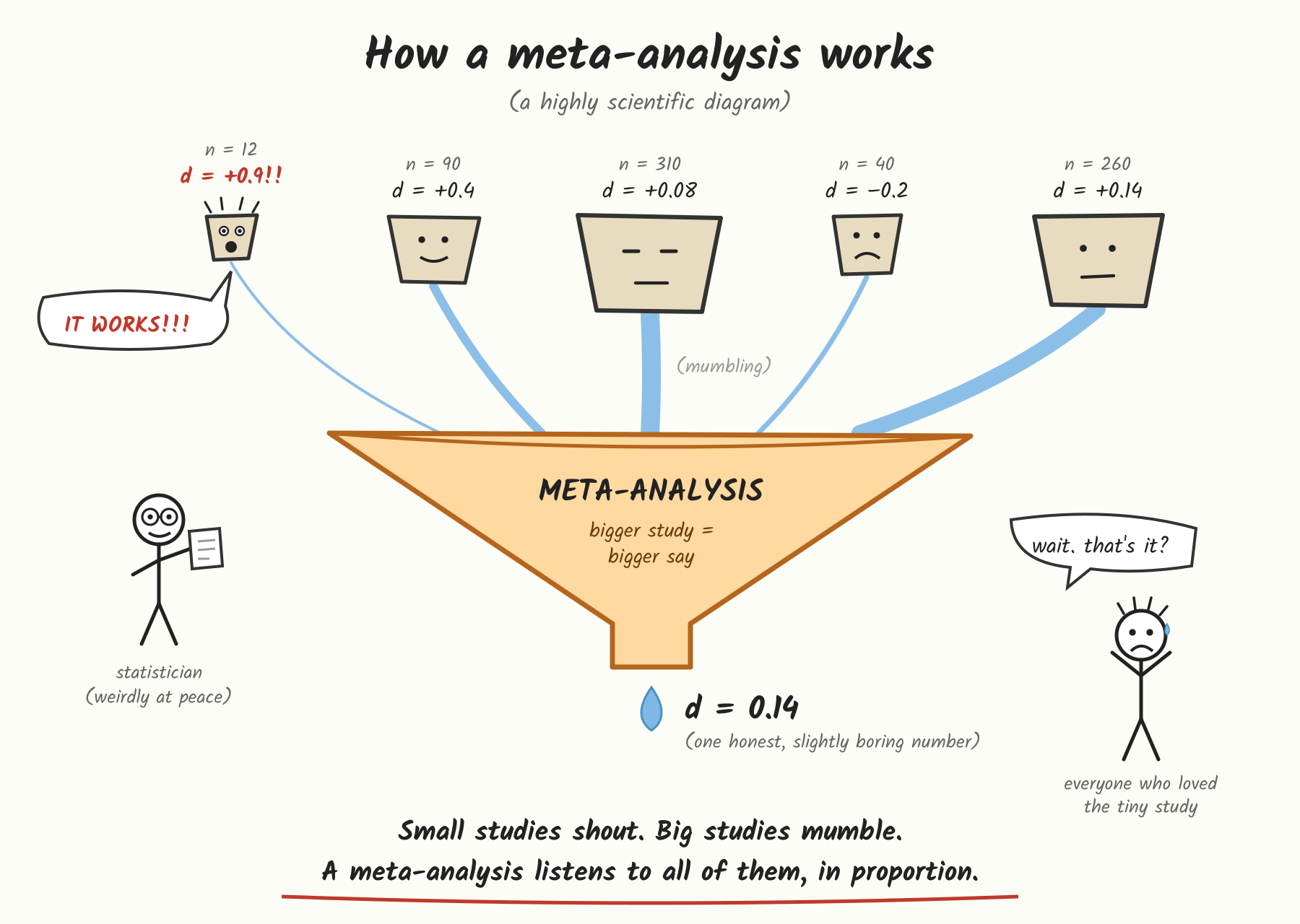
The overall effect was small (d = 0.14) and not statistically significant, and none of the three areas did meaningfully better than the others. Most of the trials also had some concerns about risk of bias. The authors' conclusion is that COSP's uptake in practice and policy has run well ahead of its evidence.
… and if your wondering what a meta-analysis is, this highly scientific diagram might help:
How far can insight get you?
My read is that Circle of Security is extraordinarily good at the first step of change, which is helping a parent see differently. What it does less of is the next step: giving the parent something concrete to do, and then having them do it, again and again, until it becomes automatic.
We see this in every field where people have to perform under pressure. Athletes, musicians and surgeons all understand the theory of what they do, and they all get good the same way: repetition, feedback and more repetition. It's probably no coincidence that the parenting programs with the strongest evidence, things like PCIT, Incredible Years and video-feedback approaches, all build in rehearsal and coaching. Parents practise the skill in the room, get feedback, and try it again at home.
Or put another way, having a solid understanding of musical concepts alone won’t allow you to pick up a guitar and play proficiently.
So for me, it's a both/and. Parents need the lens, and they need the reps.
What the wider evidence says works
It's worth zooming out here, because COSP isn't the only program that's been put under the meta-analytic microscope. Triple P, Incredible Years, PCIT and, just this year, Ross Greene's Collaborative & Proactive Solutions have all had their trials pooled.
Now, the tempting thing is to line them all up and crown whichever has the biggest number. If we did that PCIT would win that contest. But we have to be careful because the biggest predictor of a program's effect size is how much the children were struggling to begin with. One large analysis of 154 trials found effects roughly tripled as you moved from universal prevention samples (everyday families) to clinical treatment samples (the kids who really need support). Programs tested mostly on families already in crisis look stronger, and programs tested mostly in the community look weaker, almost regardless of what's in them.
The more useful question is what are the ingredients that effective programs have in common. Two big component analyses have tried to answer exactly that, by coding what each program teaches and seeing which ingredients travel with bigger effects.
The first, pooling 77 evaluations, found larger effects when programs built positive parent-child interaction and emotional communication, taught consistency and calm limit-setting (time out, in those studies), and, the one that jumped out at me, required parents to practise new skills with their own child during the session. Interestingly, teaching parents general problem-solving and bolting on extra services were associated with smaller effects. The second, across more than 150 trials, found that just three of 26 techniques predicted stronger effects: positive reinforcement, praise in particular, and natural or logical consequences.
So the recipe that keeps showing up is a warm relationship, clear and predictable limits that aren't harsh, and plenty of rehearsal with the actual child. Circle of Security is rich in the first and light on the other two, which fits the result of this recent meta-analysis pretty neatly.
The interesting wrinkle is Collaborative & Proactive Solutions. It drops rewards and consequences almost entirely, yet in head-to-head trials it performs about as well as parent management training. My read is that it keeps the deeper ingredient: a structured conversation that parents rehearse in session and then run, again and again, at home. Different mechanism, same practice loop.
Turning the lens on my own work
I'd be a bit of a hypocrite if I wrote all this without asking the same question of The Regulation Compass.
The good news is that TRC was built with one thing very deliberately in mind: strategies a tired parent can understand and remember in the moment. Tools like the 3-Step Reset, the Silent 10 and Elastic Responses are short, concrete and designed to be doable on a hard day rather than admired on a good one.
However, easy to understand and well practised are two different things. So this study has helped me realise that TRC needs to continue to build in mechanisms that prompt a parent to rehearse a tool when things are calm, try it in a real moment, reflect on how it went, and then go again. That loop of deliberate practice is where I think real change lives, and it's very likely the next evolution of the framework.
That evolution will feed straight into how we train clinicians. A clinician who can explain the Regulation Diamond clearly is useful. A clinician who can help a parent use the 3-Step Reset ten times in a fortnight, troubleshoot the attempts that didn't go to plan, and build it into family routines is far more useful. I'd like TRC training to produce more of the second kind.
The standard worth holding
Circle of Security gave a generation of practitioners a better way to see children, and I don't think anyone should throw the baby out with the bathwater. I'll keep using a lot of its language, because it helps.
But this paper is a useful reminder for everyone who builds and delivers parenting programs, me included. Any framework should be able to answer two simple questions: what does the parent actually practise, and how do we know it's making a difference for their child?
Sources
Bakermans-Kranenburg, M. J., Galbally, M., Hawkins, E., & van IJzendoorn, M. H. (2026). Research Review: No robust effects of Circle of Security-Parenting (COSP) on parenting, parents, or children. Journal of Child Psychology and Psychiatry.
Kaminski, J. W., Valle, L. A., Filene, J. H., & Boyle, C. L. (2008). A meta-analytic review of components associated with parent training program effectiveness. Journal of Abnormal Child Psychology, 36(4), 567–589.
Leijten, P., Gardner, F., Melendez-Torres, G. J., et al. (2019). Meta-analyses: Key parenting program components for disruptive child behavior. Journal of the American Academy of Child and Adolescent Psychiatry, 58(2), 180–190.
Norman, U. A., Fortune, D. G., Hehir, F., & Sachsenmaier, T. (2026). Evaluating Collaborative & Proactive Solutions across settings: Mini meta-analysis of behavioral outcomes and relational implications. Child & Family Behavior Therapy.